
News
View All News →

Join Us at the 2026 National Mobility Summit ✨
The TBD Center invites you to the 2026 National Mobility Summit on June 8, 2026, at the USC Capital Campus in Washington, D.C. The Summit will convene leaders from across government, academia, and industry to advance the movement of people and goods across the United States.
Learn more →
May 2026
Apr 2026
Jan 2026
Dec 2025
Nov 2025
Oct 2025
The Mobility Dashboard (TMD) Now Available
TBD Webinar: Telework and Travel Demand — Longitudinal Evidence
TBD Center at the 2026 TRB Annual Meeting
New Paper: Data Collection and Weighting for Consistent Population Parameters
Final Report Released: Behavioral Responses to AVs in Four U.S. Metro Areas
New Brief: AV Awareness and Perceptions from THA Wave 2
Events
Upcoming Events
Resources
Data, Tools & Briefs
Flagship surveys, interactive dashboards, and policy-ready outputs from TBD research.
Flagship Projects

Flagship Project #1
Transportation Heartbeat of America (THA) Survey
A nationally representative longitudinal survey tracking travel behavior, attitudes, and mobility trends across the U.S.
Learn More →
Flagship Project #2
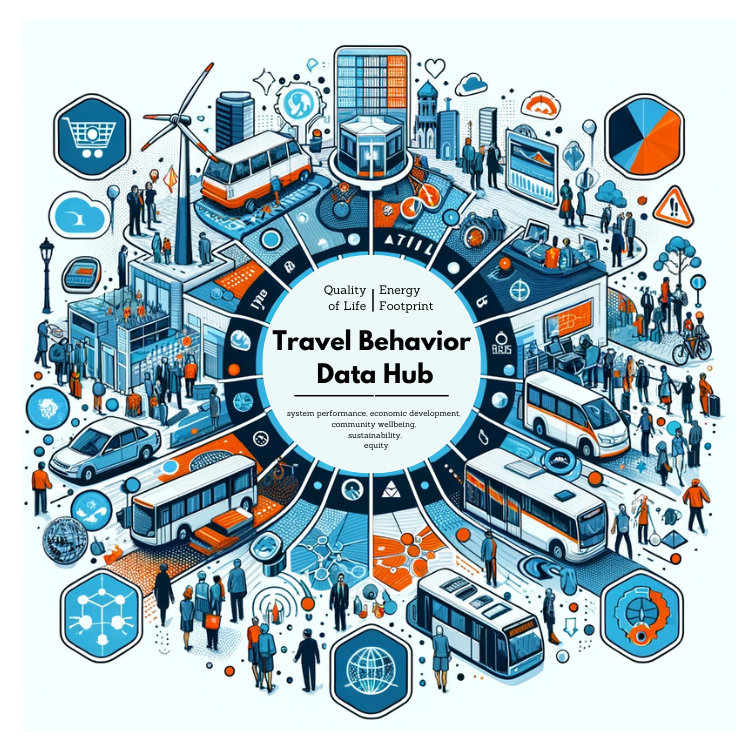
Travel Behavior Data (TBD) Hub
A centralized repository integrating national travel surveys, GPS traces, and administrative data to support open research.
Learn More →
Interactive Data Tools
View All →
The Mobility Dashboard (TMD)
National travel behavior trends across demographics and geographies.
Launch Tool →
CARE Dashboard
Community resilience explorer for extreme heat and mobility impacts.
Launch Tool →
T3D Dashboard
Travel behavior insights from the THA Survey across metro areas.
Launch Tool →
Data Briefs
View All →
1
Transportation Heartbeat of America (THA) Wave 2 Survey
2025
2
Emerging Travel Behavior Insights from 2024 National Surveys and Count Data
2024
3
Emerging Travel Behavior Insights from 2023 National Surveys
2023
4
COVID Recovery? Changing Travel Behaviors? Insights From the 2022 ACS, ATUS, and CE Data Sets
2022
Research
Discover Our Research
Recent Projects & Reports
Explore Research →
1Are We Ready? Evaluating Evacuation Preparedness, Behavior, and Vulnerability During Wildfires in Washington→
2Opportunities and Limits of Individual Behavioral Changes: Phase I→
3Real-Time Transportation Origin-Destination Demand Estimation Using Multimodality Data→
4Do Millennials and Zoomers Participate in Teleactivities More and Travel Less Than Older Generations?→
5Multimodal Freight Network Capacity and Resilience Under Demand Shifts→
6Neutralizing Onerous Heat Effects on Active Transportation (NO-HEAT) in Atlanta→
7Spatiotemporal Heterogeneous Change of Travel Behavior during Wildfires in California→
8Exploring Top-Down Visual Attention for Transportation Behavior Analysis: Walkability and Pedestrian Behaviors→
9Leveraging Vision-Language Models for Efficient Understanding of Vulnerable Roadway Users→
10Measuring the Last-Mile: Leveraging Synthetic Data to Evaluate the Effects of Urban Freight Interventions→
11Future Travel Foresight Catalyst – Phase 3→
12Enhancing the Use of Attitudinal Marker Variables in Travel Behavior Models→
13Behavior-Aware Evaluation of Emerging Vehicular Technologies→
14From Reactive to Predictive: Modeling Urban Event Impacts on Transportation Systems→
15Potential Use of Large Language Models (LLMs) for Travel Behavior Survey Research→
1Evolution of Mode Choice: Examining the Relationship Between Telecommuting and Transit Use→
2Future Travel Foresight Catalyst: Phase 1→
3Analysis and Implications of the Vehicle Inventory and Use Survey (VIUS)→
4Future Travel Foresight Catalyst: Phase 2→
5Time Use, Travel, and Telework Dashboard (T3D)→
6Measuring the Last-Mile: A Comprehensive Evaluation of Synthesis Approaches to Address Data Gaps for Local Freight Decision-Making (Phase 1)→
7The Effects of Changing Commutes on Home Delivery Activity→
8Exploring Top-Down Visual Attention for Transportation Behavior Analysis→
9Investigation of Emerging Sensing and AI/ML Technologies to Enhance the Safety of Vulnerable Roadway Users→
10Blockchain Application on Smart Transportation Systems→
11Machine Learning Based Analysis of Activity Patterns to Assess Travel Behavior in Five Boroughs of New York City→
12Vehicle Edge Computing for Travel Behavior and Demand in Future Intelligent Transportation Systems→
13How Much Do Attitudinal Variables Improve Travel Demand Models?→
14Investigating Travel Survey Representativeness: Who’s Missing and What Can We Do?→
15Enhanced Network Models for Multimodal Resiliency→
16Identifying Targets for Electric Vehicle Industry Improvement→
17A Dynamic Analysis of the Built Environment-Travel Behavior Relationship Using Three Activity-Travel Surveys in the Austin, Texas Region→
18A Model of EV Adoption and Rank-Based Contributing Factors→
19An Evaluation of the Long-Term Effects of the COVID-19 Pandemic on Public Transportation Use→
20The Reverse Side of Online Shopping: Examining Sociodemographic and Built-Environment Determinants of Delivery Returns→
Journal Articles
View All Publications →
1Alhassan, V.O., Yu, F., Batur, I. et al. Investigating the Influence of Alternative Survey Participant Recruitment Strategies on Measurement and Inference of Mobility Patterns.→
2Batur, I., Mondal, A., Alhassan, V.O. et al. The Induced Demand Implications of Alternative Adoption Modalities of Automated Vehicles.→
3Bhat, C.R. A New Flexible Skewed Bimodal Distribution with Multivariate Extensions: Theory and Application to Traffic Crash Injury Severity Analysis.→
4Chen, C., Wang, R., Bansal, P. et al. From Biases to Opportunities: Leveraging Location-Based-Service (LBS) Data for Next-Generation Transportation Planning.→
5Choi, S.-E., Kim, I., Wang, X. et al. How Has the Importance of Factors Influencing Telework Adoption Changed Over Time?→
6Conway, A. and Conway, M. The Community Impacts of Ecommerce Warehousing Growth: A Case Study of Berks County, Pennsylvania, USA.→
7Feng, G., Li, Y., Tok, A.Y.C., and Ritchie, S.G. Domain Informed Vision Language Model for Sustainable Freight with Drayage Truck Powertrain and Cargo Classification.→
8Hwang, U., Mokhtarian, P.L., Koo, B.W., and Guhathakurta, S. Perceived Streetscape Quality and Bike Lane Effectiveness: A Computer Vision Approach.→
9Kim, I. and Mokhtarian, P.L. How Much Do Attitudinal Variables Improve Travel Demand Models?→
10Kim, S.H., Wang, X., and Mokhtarian, P.L. Quantifying Aggregate-Level Telework Occasions and Their Impacts on Vehicle-Miles Traveled in the US.→
11Li, Y. and Zhang, M. Understanding the Emerging Interregional Travel Amid Shifting Societal and Technological Trends.→
12Oshanreh, M.M., Khan, N.A., and MacKenzie, D. Propagating Synthetic Populations with Dynamic Bayesian Networks: A Framework for Long-Horizon Demographic Forecasting.→
13Rezapour Fardin, F., Morvan-Chevestre, M.L., and Conway, A. How Teleworking Affects Online Shopping and Home Delivery: A Joint Modeling Perspective from Post-Pandemic New York City.→
14Robbennolt, D., Haddad, A.J., and Bhat, C.R. A Rank-Based Model of Residential Location Preferences Before and During the COVID-19 Pandemic.→
15Robbennolt, D., Pendyala, R.M., and Bhat, C.R. Data Collection, Weighting, and Modeling Techniques to Estimate Consistent Population Parameters.→
16Tu, Y., Oshanreh, M.M., Khaloei, M. et al. Effect of Trip Attributes on Ridehailing Driver Trip Request Acceptance.→
17Wang, Z., Oshanreh, M.M., and MacKenzie, D. A Hybrid Temporal-Spatial Framework for Understanding Public EV Charging Usage Patterns: Evidence from Bay Area.→
18Yang, Y., Li, X., Guo, Y. et al. Understanding Joint Travel–Charging Decisions of Battery Electric Vehicle Users During Typhoons.→
19Robbennolt, D., Pendyala, R.M., and Bhat, C.R. Data Collection, Weighting, and Modeling Techniques to Estimate Unbiased Population Parameters.→
Our Focus Areas
Research Innovation Areas
TBD’s research aims to unravel the interlinked behavioral processes shaping the movement of passengers and goods, anchored in three key innovation areas. Explore Our Research Areas →
Thrust 1
Data Collection Mechanisms
Good data is critical to decision-making. A key focus of TBD is data collection, focusing on the methods for collecting, compiling, and fusing disparate data sources to build a robust evidence base for transportation research.
Thrust 2
Data Modeling and Analytic Tools
Harnessing new algorithms and software platforms to build models and dashboards capable of providing actionable information to policymakers and transportation planners.
Thrust 3
Understanding User Needs
Focusing on the user through a management lens, advancing policies and investments to address user needs in a heterogeneous population with a view toward equity and accessibility.